} /* Footer ----------------------------------------------- */ #footer { width:660px; clear:both; margin:0 auto; padding-top:15px; line-height: 1.6em; text-transform:uppercase; letter-spacing:.1em; text-align: center; } -->
This blog is for my Middle Eastern Studies Class. The following posts will share information with you regarding the American role in the Middle East, Islam and Democracy, and the Culture in the Middle East. Feel free to comment on one or all of them! Thank you!

Search This Blog

Saturday, May 22, 2010

America's role in the Middle East


After looking at the following articles, How did the United States become involved in Middle Eastern Affairs? Would you agree that the lack of consultation and communication between the US and their ally, Israel, is affecting the American role in the Middle East? Would you agree or disagree that the Americans should be playing a strong role in the Middle East? What do you predict will be the American role in the middle east in 2020? Will it be strengthened or weakened? Answer based on the previous events of American control in the Middle East.


"America & the Middle East: U.S. involvement in the Mideast goes back 200 years. It's a complicated tale of American idealism, strategic interests, and the uses of military power"


Define Democracy.


Dr. Khalifa Abdul Hakim, a Pakistani scholar, philospher, and writer stated in his book, "The Prophet and His Message",

"The subject of the relation of Islam to democracy would present further difficulties, because democracy seems to have become as undefinable as religion or love. From the beginning of democracy, in any part of the world, up to the present times, (when it almost seems to have taken the place of religion as an ideal or a way of life) opinions about its nature and value have been divergent and contradictory."

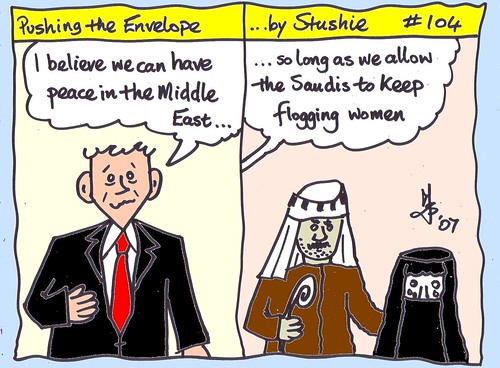
How do you describe democracy? Would you agree or disagree with Dr. Hakim's statement? When considering Islam and democracy, do you believe that democracy would disrupt the spiritual freedom within Islamic countries, or could it benefit places such as Saudi Arabia, where Islam is the foundation for their politics?

Just a taste of the Middle Eastern cuisine...


The cuisine of the Middle East has earned the reputation of being flavorful, healthy, and fresh. Popular foods include a type of pasta called tahini, hummus, falafel, and various fresh fruits and vegetables. After looking at the following recipes of popular dishes in the countries of Saudi Arabia (Kapsa Chicken Rice), Lebanon (Lamb Sharwarma), and Iran (Kabab Barg), what similarities/differences do you see between the ingredients used in the Middle East and those you often use in the US? What do the recipes tell you about the countries that they come from, and about the Middle Eastern cuisine as a whole? How could one change the US cuisine to healthier choices such as found in the middle east?

Tuesday, May 18, 2010

Culture in the Middle East.

How does Hollywood portray Muslims and people of Middle Eastern descent in American film? Has our fear of terrorism effected the way in which Hollywood makes and markets movies? Has a drive for political correctness convinced American film makers to stay away from negative depictions of Middle Easterners? Often Hollywood portrays Muslims as good, for instance in the film Kite Runner the Muslim culture is presented in a positive light. Sometimes the Middle East is portrayed in an impartial light, such as in the move Babble. Other times Muslims are portrayed as villans like in the film Taken. Post a link to a scene from another movie that also portrays Muslims in a certain light, and explain whether it is a good or bad portrayal and why you believe that.